What's really changing in property managers' day-to-day
By consolidating the feedback of more than 200 vacation rental professionals (clients and prospects alike) shared with our teams between 2024 and 2026, we identified the major axes transforming security deposit management in the sector. No theory. No prefab headlines. What actually comes up in every conversation with a property manager.
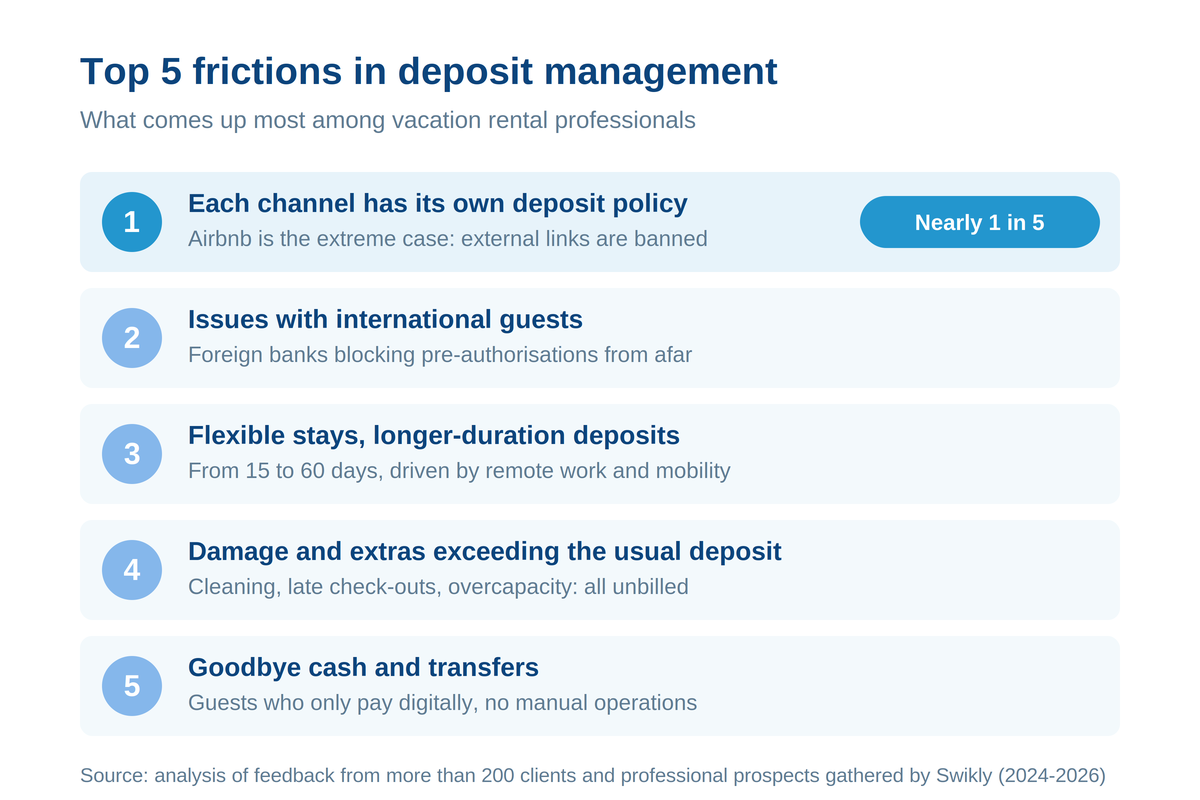
Five insights stand out clearly: five frictions that are no longer anecdotal but structural, reshaping how deposits are requested, managed and released in vacation rentals.
Insight 1 · Each channel, its own deposit policy
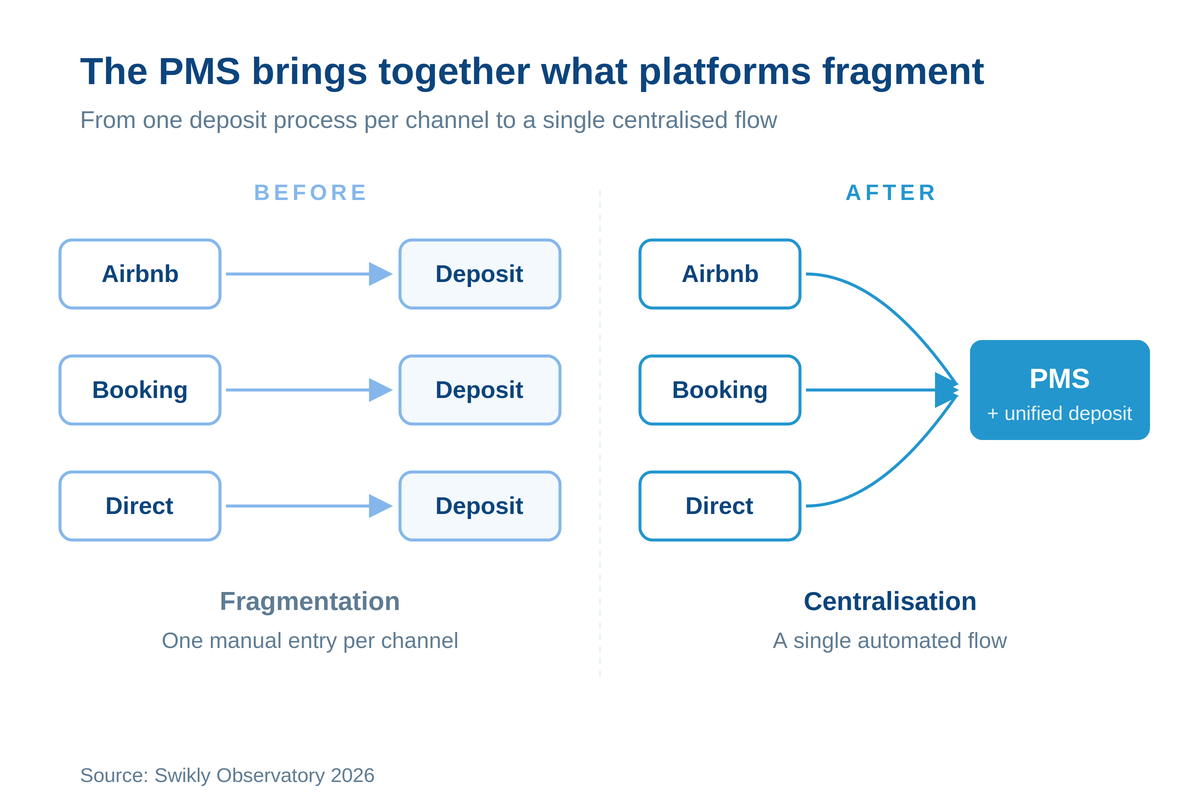
Anyone managing a multi-channel portfolio (Airbnb, Booking, direct website) ends up arbitrating, booking after booking, between very different frameworks. Each platform defines its own conditions, its own limits, its own way of communicating with the guest.
The most visible case is Airbnb: nearly 1 in 5 professionals we spoke with raises the same blocker. Service conditions prohibit sending the guest an external link to collect the deposit, at the risk of compromising listing visibility.
"On Airbnb, you can't send the deposit link directly: your listing is on the line."
Property manager consulted as part of the Observatory
When this restriction combines with Booking's particularities and the total freedom of direct bookings, the result is operational fragmentation: duplicated processes, tracking errors, and hours lost balancing releases. This reality is what is pushing the PMS ecosystem into a central role: specialised platforms like Swikly maintain over 50 native integrations with the most-used PMS in the sector, a figure that was inconceivable just five years ago.
Insight 2 · Friction with the international guest
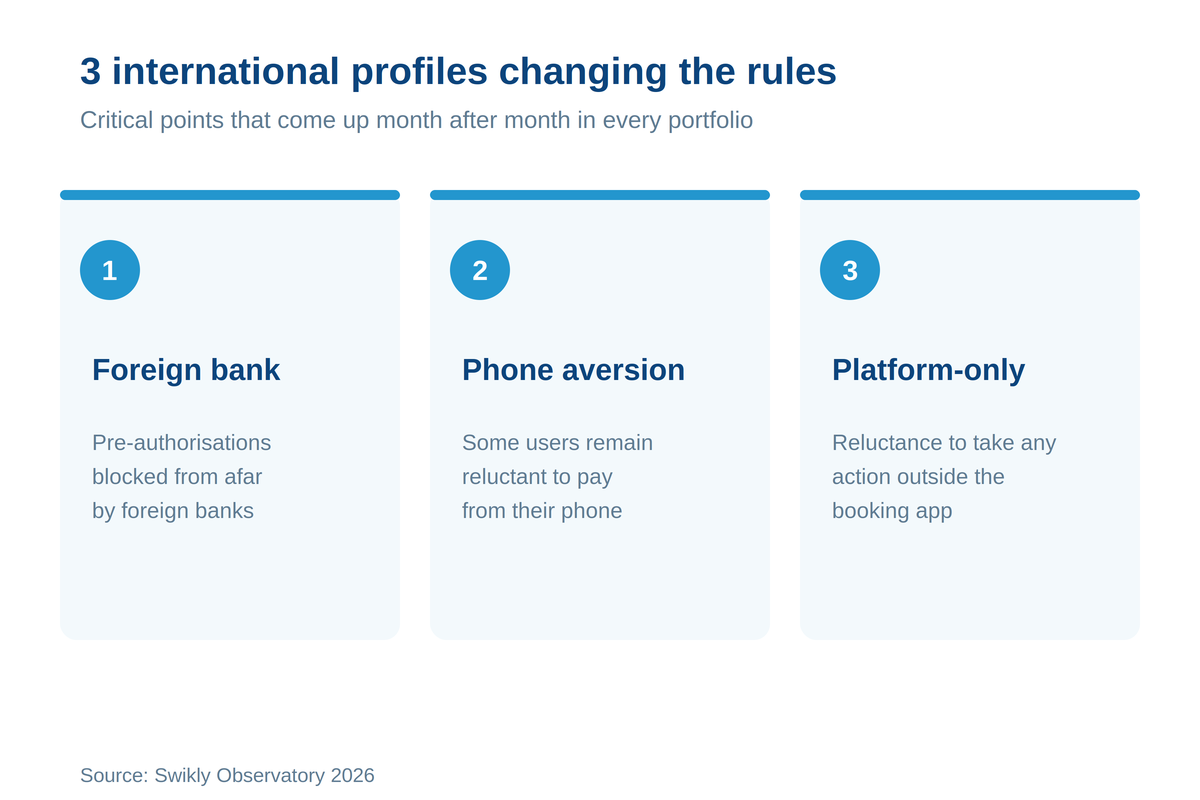
Vacation rentals thrive on the diversity of guest profiles. And that diversity generates, month after month, the same three critical points: pre-authorisations that get blocked with foreign banks, guests unfamiliar with digital payments from their phone, and profiles that reflexively reject any additional action outside the booking platform.
What would go unnoticed with a local clientele becomes systemic when the guest comes from another country. Anticipating these profiles is no longer optional: it's part of the very design of the check-in process.
Insight 3 · Flexible stays require longer-duration deposits
Another pattern has consolidated over the past two years on the French market: the rise of medium-term stays, from fifteen to sixty days, driven by remote work, digital nomads and professionals on the move. The recent tightening of short-term rental regulations in dense urban areas accelerates the shift: many property managers now integrate the bail mobilité (the French furnished mid-term lease) and longer stays into their portfolios. This type of booking is no longer marginal: it occupies a growing share of activity.
The operational problem is direct. Standard banking pre-authorisations expire after a few days, while the stay can extend for several weeks. The property manager finds themselves without effective coverage precisely during the period when damage risk accumulates. Tools designed for the classic weekend vacation rental simply don't fit this framework.
Anticipating this reality means having a deposit instrument with a much longer lifespan than the usual banking window, capable of remaining active for weeks without forcing the property manager to manually reauthorise on a regular basis.
Insight 4 · Damage and extras above the usual deposit
A second category of friction appears after the stay, not before. Additional cleaning when the guest leaves the property in an abnormal state. Late check-outs. Undisclosed extra occupancy. Small damages that are hard to quantify but recurring.
Most of these costs are never claimed back, simply because the usual tools don't allow them to be managed with enough traceability to avoid confrontation with the guest. Yet, across an annual portfolio, what remains unbilled represents a considerable revenue leak. More and more property managers are integrating these extras into their deposit logic from the start, no longer as an after-the-fact claim, but as coverage planned in advance.
Insight 5 · Goodbye cash and transfers
The digital transition of the deposit is no longer a future horizon: it's the present. Cash and manual bank transfers, once dominant, are today incompatible with most real situations in the sector. International guests don't want to organise wire transfers from abroad. Younger guests operate exclusively from their phone. Older guests value the simplicity of a clear digital process, not the inconvenience of arranging a manual transfer.
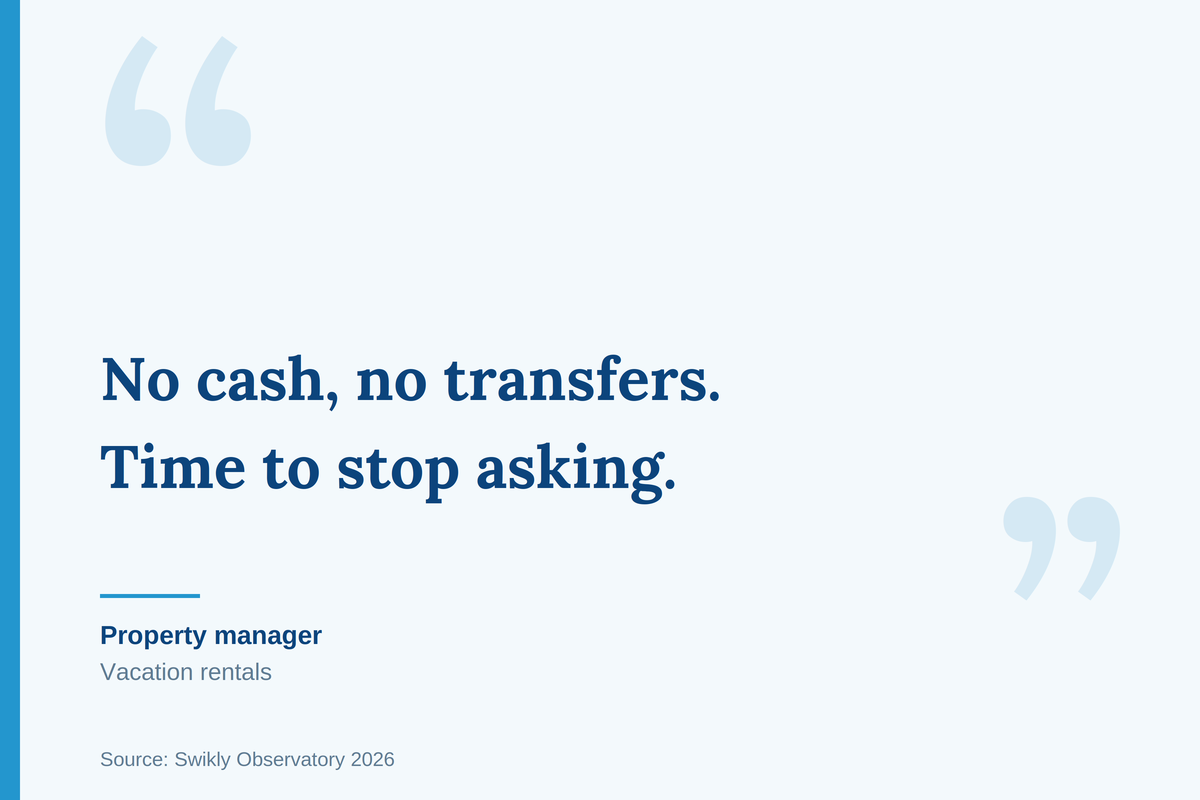
"With foreign guests, I don't want to handle cash or transfers: they only pay digitally."
Vacation rental manager consulted as part of the Observatory
What's happening isn't a gentle evolution: it's a complete substitution, within a few years, of the legacy model. Those who don't anticipate it will face growing friction with their own clients.
In summary
The ground tells a more nuanced story than the headlines. Security deposit management in vacation rentals is no longer a secondary administrative task: it has become a critical point connecting the guest experience, operational profitability and multi-channel compliance. Property managers who integrate it in a structured way, within a PMS, with a digital process adapted to international profiles and full post-stay coverage, are also the ones reclaiming margin and drastically reducing their operational hours.